
Written by the Harmukh Technologies SEO team based on audits conducted across Indian business websites since 2014. Last updated: July 2026.
Over the past few years, running audits on hundreds of Indian business websites, a pattern has emerged so consistently it is now the first thing we look for. Nearly every site that has plateaued — rankings flat, traffic stagnant, authority not building the way it should — has the same root cause. It is not a lack of content. It is a build-up of the wrong content.
Growth-focused audits are excellent at finding opportunities to add. The blind spot is that most audits never ask what to remove. This post is about that second question — why it matters as much as the first, and how to approach it systematically. If you’re weighing an AI SEO push on top of your existing content, this same blind spot is exactly what to check first — see our guide on what nobody tells business owners before they approve an AI SEO strategy.
In This Guide
- The growth-only blind spot: why adding more content often makes things worse
- Why content pruning matters: three ranking mechanisms it directly affects
- How to decide what to remove: the four-question decision framework
- The balanced audit: clean first, grow second
- Frequently asked questions about SEO audits and content pruning
1. The Growth-Only Blind Spot

The standard SEO audit follows a predictable structure: crawl the site, find technical errors, identify content gaps, map keyword opportunities, build a prioritised action list. This is valuable work. But it is built entirely around a single question — what can we add or fix to drive more growth? The question it never asks is: what is on this site that is actively working against us?
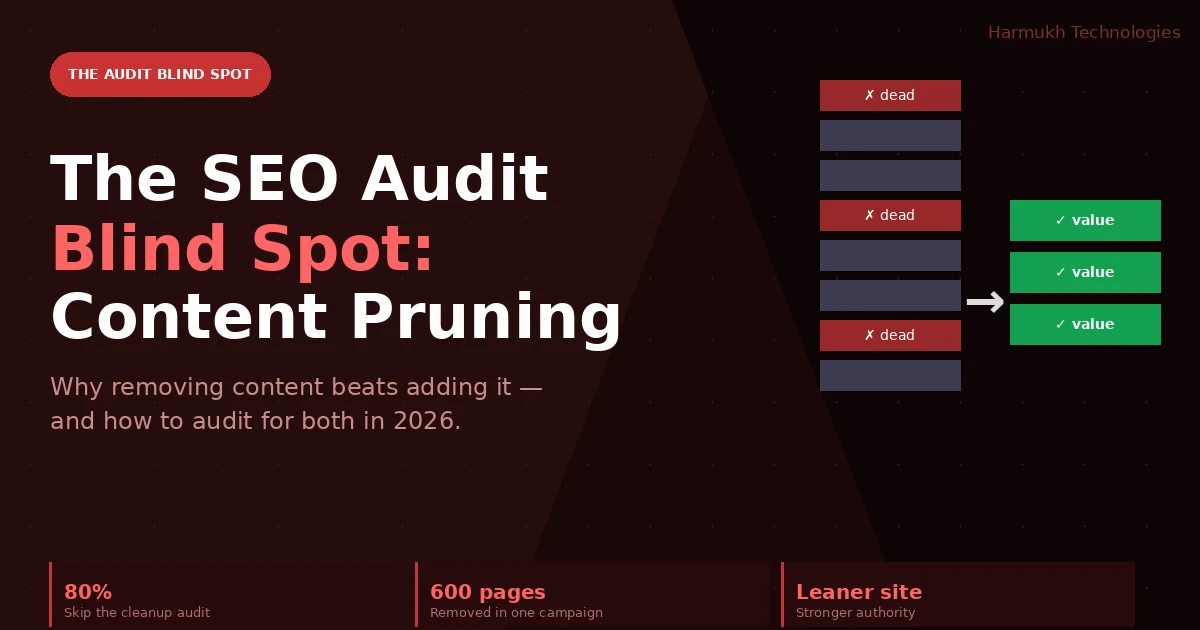
In our experience, approximately 80% of site owners skip the cleanup audit entirely. The instinct is to publish more content to “keep up” — more blog posts, more landing pages, more category pages. This is the digital equivalent of building a new floor on a crumbling foundation. Layering fresh content on top of a large volume of outdated, thin, or irrelevant pages does not dilute the damage — it compounds it. Google evaluates your site as a whole entity, not just your newest pages. A body of weak content affects how it perceives your expertise on every topic you cover.
This growth obsession is exactly what we described in our breakdown of why churning out blog posts for SEO is often a waste of time and money — volume without quality, and especially volume without maintenance, produces diminishing returns that eventually become negative returns. The audit blind spot is what turns that diminishing return into a plateau.
This pattern is particularly acute for Indian business websites that went through a phase of high-volume content production between 2021 and 2024 — often using content agencies or AI-assisted tools to publish at scale. The February 2026 Core Update specifically targeted these accumulated bodies of thin, AI-generated, or low-expertise content, and the March 2026 spam update reinforced the same pattern shortly after — see our dedicated post on what the March 2026 spam update actually changed. Sites affected by either update were not penalised for a single bad page — they were penalised for a pattern that had been building for years. The cleanup audit is how you identify and reverse that pattern.
2. Why Content Pruning Matters — Three Mechanisms

Content pruning is not a housekeeping task. It is a strategic intervention with documented, measurable impact on three distinct ranking mechanisms.
Topical authority dilution
Google’s topical authority model evaluates how comprehensively and authoritatively a site covers a subject area. A site with 400 deeply researched articles on a single topic will outrank a site with 2,000 articles spread thinly across loosely related topics — even if the thinner site has more pages and more overall content. When a site publishes outdated, shallow, or off-topic content alongside its strongest work, it sends conflicting signals about what the site genuinely specialises in. Pruning removes the signal noise and sharpens Google’s understanding of your core expertise.
This is the mechanism behind why a leaner site consistently outperforms a bloated one — it is not about size, it is about coherence. As we cover in our analysis of what still actually works in SEO in 2026, topical depth and subject coherence have consistently strengthened as ranking signals across every major algorithm update cycle. This same principle underpins why backlink acquisition is also more effective for leaner, topically coherent sites — authoritative sites are more likely to link to a resource from a site that clearly specialises in a subject than one that publishes on everything loosely.
Crawl budget efficiency
Googlebot does not crawl every page on your site on every visit. It allocates a crawl budget based on your site’s authority and crawl rate history. If a significant portion of your crawlable pages are low-value — zero traffic, no backlinks, thin content, outdated information — Googlebot spends that budget on pages that cannot contribute to rankings. Meanwhile, your genuinely valuable pages may be crawled less frequently than they deserve, meaning new content takes longer to index and updates take longer to reflect in rankings.
Removing or consolidating low-value pages redirects crawl attention toward the content that actually matters. For larger sites with thousands of indexed pages — a common situation for Indian e-commerce and service directory sites — crawl budget efficiency can be the single largest factor in how quickly ranking improvements after a content overhaul take effect.
Algorithm update resilience
Sites that are disproportionately affected by broad core updates are almost never penalised for one bad page. They are penalised for the cumulative weight of many low-quality pages dragging down the site’s overall quality assessment. Google’s Helpful Content system evaluates site quality holistically — a site with a large proportion of unhelpful content will have that assessment applied across all its pages, including its good ones.
The February 2026 Core Update operated on exactly this principle, and Google has continued to reinforce it across the three updates that followed through the rest of the year — see our full breakdown of all four 2026 updates for the complete pattern. The sites that recovered fastest after being affected were those that pruned aggressively and quickly — not those that published more new content to compensate. In our own client work, we saw recovery timelines accelerate significantly when pruning preceded new content production, compared to clients who attempted to recover by publishing their way out of the penalty. As we document in our guide on how SEO actually works in the AI era, the shift toward holistic site quality evaluation — rather than page-by-page assessment — makes content pruning a core part of any sustained SEO programme, not an occasional cleanup task.
3. How to Decide What to Remove — The Decision Framework

Not all underperforming content should be deleted. The decision requires a consistent framework applied across every page. In a recent audit of a site with over 2,000 content pieces, we found that roughly 600 articles were outdated, misaligned with current search intent, and generating zero traffic. These were systematically removed or 301-redirected to preserve any residual link equity. A further 250 posts were not complete losses — they had the right topic but the wrong format or depth. These were refurbished, often into structured Q&A formats aligned with current intent signals, and retained. The remaining content formed a genuinely strong corpus that the site could build authority from.
The four-question framework
The framework we apply to each page asks four questions in sequence.
Question 1: Does this page receive any meaningful organic traffic in the last 12 months?
Check Google Search Console. Look at impressions and clicks over a rolling 12-month window. If both are effectively zero — under 50 impressions per month and no clicks — the page has no existing search visibility worth preserving. This does not automatically mean deletion, but it means the page is contributing nothing and needs to pass the remaining questions to justify retention.
Question 2: Does this page have any backlinks worth preserving?
Check Ahrefs, Semrush, or Google Search Console’s links report. If the page has backlinks from relevant, authoritative domains, those links represent equity worth retaining even if the page itself underperforms. The solution here is a 301 redirect to the most topically relevant live page, not deletion — this passes the link equity to a page that can actually benefit from it. If the page has no backlinks, deletion or noindex are both clean options.
Question 3: Does this page cover a topic genuinely relevant to our core subject area and audience today?
If the answer is no — if it was published for a trend that has passed, targets a keyword that no longer reflects real search behaviour, or covers a product or service no longer offered — it has no strategic value regardless of its technical status. Pages that answer yes here have a reason to exist even if they need significant work. Pages that answer no should be removed regardless of their traffic or link history.
Question 4: Can this page be meaningfully improved and made genuinely useful within a reasonable effort?
This is the refurbishment question. Some underperforming pages are underperforming because they cover the right topic in the wrong format, at the wrong depth, or targeting outdated search intent. These are worth fixing. Others are structurally too thin, too narrow, or too misaligned to rescue without essentially rewriting them from scratch — at which point it is more efficient to create a new, better page and redirect the old one to it.
The three outcomes
Remove with 301 redirect: Zero traffic, zero or minimal backlinks (redirect to most relevant live page if backlinks exist), not relevant to core subject area, not worth refurbishing. This is the most common outcome for content published during high-volume phases — typically 25–40% of total indexed pages on sites audited after aggressive content production periods.
Refurbish and retain: Zero or low traffic, relevant topic, improvable with reasonable effort. These pages go into a prioritised refurbishment queue. Refurbishment means restructuring for current search intent, adding original data or expertise, improving internal linking, and where appropriate converting to a format — structured Q&A, comparison table, step-by-step guide — that better matches how users and AI systems are processing this type of query in 2026. Our guide on proven strategies for ranking higher on Google covers the specific on-page signals that refurbished content needs to target.
Retain and strengthen: Receiving traffic, relevant, no immediate issues. These pages form the core of the existing content asset and are the ones the growth phase of the audit should be linking to and building authority around. For each retained page, the audit should identify internal linking opportunities from new content and check whether the page itself is optimised to benefit from the site’s improving overall authority signal.
Practical tools for the content audit process
For a site under 500 pages, Google Search Console combined with a Screaming Frog crawl and a free Ahrefs or Semrush account provides sufficient data. Export all indexed URLs from GSC, match them against 12-month click and impression data, identify the zero-traffic pages, cross-reference with your backlink tool, and apply the four-question framework to each. This is painstaking work — for a 500-page site, expect 2–4 days of focused analysis before you arrive at a confident remove/refurbish/retain list.
For sites above 1,000 indexed pages, a paid Ahrefs or Semrush account with bulk URL analysis is worth the investment specifically for this exercise. The ability to pull organic traffic data, backlink counts, and referring domain quality for every page in a single export reduces the analysis time dramatically and produces a more defensible prioritisation framework.
4. The Balanced Audit — Growth and Garbage Disposal

The most sustainable SEO gains we have seen come from a sequenced approach: clean first, grow second. The cleanup audit — identifying what to remove, what to refurbish, and what to consolidate — should precede the growth audit, not follow it. Publishing new content on a site with unresolved quality issues is precisely what produces the pattern of diminishing returns that leads teams to question whether SEO is working at all.
In practical terms, a complete audit now follows this three-phase structure.
Phase 1 — Content inventory and pruning. Every indexed page assessed through the four-question framework above, producing three lists: remove, refurbish, and retain. The remove list is actioned first — 301 redirects implemented, pages deleted, removal requests submitted via Google Search Console’s URL removal tool for any previously indexed pages that need faster de-indexing. The refurbishment queue is prioritised by topic relevance and improvement effort — quick wins first, structural overhauls later. This phase typically takes 2–6 weeks depending on site size.
Phase 2 — Technical health. Core Web Vitals, crawl errors, indexation issues, internal link structure, schema markup coverage, canonical tag integrity, mobile usability. The reason this phase follows content pruning rather than preceding it is that the crawl data is more meaningful once low-value pages have been removed — you are diagnosing the health of pages worth keeping, not the health of the entire crawled index including pages destined for deletion. Our SEO services page covers the full technical audit scope for clients who need this done professionally.
Phase 3 — Growth opportunities. Only at this stage does the traditional growth-focused audit work begin. Keyword gap analysis, content cluster gaps, competitor weaknesses, new pages to build, backlink acquisition targets. This work now lands on a site that has been prepared to actually support it — cleaner authority signals, better crawl efficiency, stronger topical coherence. New content published at this stage indexes faster, ranks faster, and builds authority faster than it would have on the pre-pruned site. For the growth phase execution framework, our 90-day SEO plan gives you the tactical detail.
This sequencing changes the economics of SEO investment significantly. Teams that clean before they build see new content perform better faster, because the site’s overall quality signals are stronger. They see algorithm update resilience improve. They see crawl efficiency increase. And they stop the pattern of publishing content that adds to the problem rather than solving it.
The next time you open a crawl report, the first question is not “what should we add?” — it is “what should we remove?” Your long-term search visibility depends on both, in that order. For a broader view of how this fits into where SEO is heading in 2026, and why site-wide quality signals are becoming the primary ranking variable, the full strategic picture is laid out in our analysis of the SEO trends that will define this year.
Frequently Asked Questions: SEO Audits and Content Pruning
What is content pruning in SEO?
Content pruning is the process of systematically identifying and removing, consolidating, or refurbishing underperforming, outdated, or low-quality pages from a website. The goal is to improve the site’s overall quality signals — topical authority coherence, crawl budget efficiency, and Helpful Content assessment — by reducing the proportion of pages that are contributing nothing or actively dragging down the site’s quality profile. Pruning is the opposite of the default instinct to publish more; it asks what already on the site is working against you.
How do I know if my website needs a content pruning audit?
Five signals indicate a content pruning audit is overdue: rankings have plateaued or declined despite consistent new content production; the site has a large number of pages with zero organic impressions in Google Search Console over the past 12 months; the site was negatively affected by a recent Google core update, particularly the February 2026 Core Update, the March 2026 spam update, or later Helpful Content system updates; the site went through a period of high-volume content production between 2021 and 2024 using content agencies or AI tools; or the site covers a very broad range of topics and lacks clear topical focus in any single subject area.
Is it safe to delete pages from my website for SEO?
Yes, with the right process. Pages with no organic traffic and no backlinks can be deleted cleanly. Pages with backlinks — even if traffic is zero — should be 301-redirected to the most topically relevant live page rather than deleted, to preserve the link equity they carry. Pages that are deleted without 301 redirects from URLs that have inbound links will return a 404 error, causing that link equity to be lost. The key safety check before any deletion is always: does this URL have backlinks? If yes, redirect. If no, delete or noindex as appropriate.
How long does a content audit take?
For a site under 200 pages, a thorough content audit applying the four-question framework takes approximately 1–2 days of focused work. For a site between 200 and 1,000 pages, expect 3–5 days. For larger sites above 1,000 pages, a professional content audit typically takes 1–3 weeks depending on the depth of analysis required. The implementation phase — actually making the redirect changes, submitting removal requests, and beginning the refurbishment queue — is additional time on top of the analysis phase.
What is the difference between a content audit and an SEO audit?
A standard SEO audit primarily covers technical health — crawl errors, page speed, Core Web Vitals, indexation, schema markup, internal linking, and growth opportunities. A content audit specifically evaluates the quality, relevance, and strategic value of every existing page on the site, producing remove/refurbish/retain decisions for each. A complete and balanced SEO programme requires both. Our recommended sequence is content audit first, then technical audit, then growth planning — because the technical audit is more meaningful once you know which pages are worth keeping.
Does removing content hurt SEO rankings?
Removing genuinely low-quality, zero-traffic, zero-backlink pages does not hurt rankings and typically improves overall site quality signals within 1–3 months as Googlebot re-crawls and re-assesses the cleaned site. Removing pages that do have organic traffic — even low traffic — can temporarily affect rankings for those specific terms. The decision to remove a traffic-generating page should be made carefully and usually only when the page covers a topic no longer strategically relevant to the business, and even then a 301 redirect to a related page is preferable to clean deletion.
How does content pruning relate to Google’s 2026 algorithm updates?
The February 2026 Core Update specifically evaluated site-wide content quality, not just individual pages, and the March 2026 spam update reinforced the same standard shortly after. Sites with large proportions of thin, AI-generated, or low-expertise content were assessed negatively across their entire domain — including their best pages. Both updates align closely with Google’s Helpful Content system, which has always been a site-level signal. Content pruning is the primary recovery mechanism for sites affected by either update: reducing the proportion of unhelpful content improves the site-level quality assessment, allowing Google to re-evaluate the good content on the site more favourably. Sites that attempted to recover purely through new content production without pruning saw slower recovery timelines than those that pruned first. See our full breakdown of all four 2026 updates for the complete picture.
Should I hire an SEO consultant to do a content audit?
For sites under 200 pages with a clear topical focus, a DIY content audit following the framework in this guide is feasible. For larger sites, sites affected by recent algorithm updates, or sites with complex content architecture — multiple categories, legacy content going back many years, significant backlink profiles on older pages — a professional content audit produces faster, more defensible decisions and avoids the common mistake of removing pages that have hidden strategic value. Our guide to hiring an SEO consultant covers what to look for in an audit engagement and the questions to ask before any content removal decisions are made.
For the full framework on how auditing, content strategy, and authority building connect into a single campaign structure, see our 90-day SEO plan and the digital marketing roadmap for 2026. If you need an independent audit of your current site’s content quality — particularly if rankings have plateaued or you have been affected by a recent algorithm update — our guide to hiring an SEO consultant covers what to look for and what a proper audit engagement should include. You can also contact us directly for an honest assessment of where your site stands.